The Yogic Prescription for Modern Living
BY BHUSHAN BHUKTE
Health is not the absence of disease, happiness is not the pursuit of pleasure and desire, and harmony is not the absence of conflict and disagreement. Together they form the very essence of Yoga—a conscious way of living that integrates body, mind, emotions, and spirit.
The Yogic Vision of Health
The Ayurvedic sage Sushruta described health in beautifully holistic terms:
समदोषः समाग्निश्च समधातुमलक्रियः।
प्रसन्नात्मेन्द्रियमनः स्वस्थ इत्यभिधीयते॥
samadoṣaḥ samāgniśca samadhātumalakriyaḥ,
prasannātmendriyamanaḥ svastha ityabhidhīyate॥
“A healthy person is one whose doshas, digestive fire, tissues, and elimination are in balance, and whose soul, senses, and mind remain cheerful and content.” —Sushruta Samhita, Sutrasthana, Ch. 15, Shloka 10
According to Sushruta, a healthy individual is one in a state of equilibrium—where the doshas [humors], agni [digestive fire], dhatus [tissues], and mala kriya [excretory functions, including urination and defecation] are all in balance, and whose atma [soul], indriya [senses], and manah [mind] remain cheerful and content.
This vision of health as balance across body, senses, and mind finds deeper resonance in the Taittiriya Upanishad, which describes the human being as composed of five progressively subtler sheaths, or panchakosha—the physical body [annamaya], the vital energy body [pranamaya], the mental and emotional body [manomaya], the intellect and wisdom body [vijnanamaya], and the innermost sheath of bliss [anandamaya]. True health, in this vision, cannot be sustained by attending to the physical body alone; it requires nourishing all five dimensions together.
Yoga nurtures this integrated state, cultivating health, happiness, and harmony.
This holistic vision resonates with the World Health Organization's modern definition: “Health is a state of complete physical, mental and social well-being and not merely the absence of disease or infirmity.”
“Health is a state of complete physical,
mental and social well-being and not
merely the absence of disease or infirmity.”
The Eight Limbs of Yoga for Holistic Health
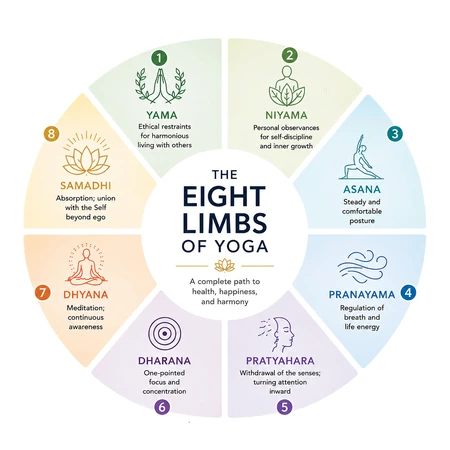
Maharishi Patanjali’s Ashtanga Yoga offers a systematic pathway to health, happiness, and harmony. It is a complete science of conscious evolution that transforms every dimension of human existence through disciplined practice. Patanjali names these eight limbs directly:
यमनियमासनप्राणायामप्रत्याहारधारणाध्यान
समाधयोऽष्टावङ्गानि॥
yama-niyama-āsana-prāṇāyāma-pratyāhāra-dhāraṇā-dhyāna-samādhayo’ṣṭāv aṅgāni ॥
“Yama, niyama, asana, pranayama, pratyahara, dharana, dhyana,
and samadhi are the eight limbs of Yoga.” —Yoga Sutra II.29
Practiced together, these eight limbs yield a specific transformation, as Patanjali goes on to describe:
योगाङ्गानुष्ठानादशुद्धिक्षये ज्ञानदीप्तिराविवेकख्यातेः॥
yogāṅgānuṣṭhānādaśuddhikṣaye jñānadīptirāvivekakhyāteḥ ॥
“Through the dedicated practice of the limbs of Yoga, impurities are removed, the light of wisdom shines forth, culminating in discriminative discernment.” —Yoga Sutra II.28
Patanjali clearly outlines this transformative process: practice of the eight limbs → removal of impurities [asuddhi-ksaya] → awakening of the light of knowledge [jnana-dipti] → discriminative discernment [viveka-khyati].
The eight limbs represent a progressive journey from outer discipline to inner realization, nurturing every aspect of human well-being.
Yama and niyama: social and personal health—the ethical foundations of Yoga cultivate harmonious relationships, self-discipline, and dharmic living.
Asana and pranayama: physical health—conscious movement and regulation of prana build stability, vitality, and physiological balance.
Pratyahara and dharana: mental health—withdrawing the senses and cultivating one-pointed attention restore mastery over the mind.
Dhyana and samadhi: spiritual health—meditation brings expanded awareness, inner peace, and realization of our true nature.
Thus, Ashtanga Yoga is far more than a sequence of techniques—it is a complete way of life. As sincere practice progressively removes impurities, the practitioner evolves toward dynamic physical well-being, mental equanimity, social harmony, and spiritual awakening. In this lies Yoga’s timeless promise of health, happiness, and harmony.
Yoga as a way of life reflects dynamic well-being—health, happiness, and harmony—and a progressive movement from bahiranga [outer limbs] to antaranga [inner limbs], rather than presenting the limbs as rigidly compartmentalized.

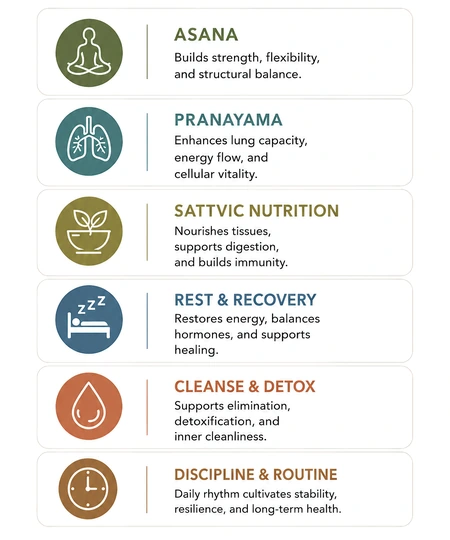
Through asana, pranayama, shuddhi kriyas [yogic cleansing practices],
relaxation, ahar [diet], and appropriate lifestyle choices,
Yoga strengthens and rejuvenates this
sacred instrument.
Health: Cultivating a Strong and Resilient Body
As the popular saying goes, “पहला सुख निरोगी काया” [pahla sukh nirogi kaya]—“The first happiness is a healthy body.” This everyday wisdom echoes an older Sanskrit teaching:
शरीरमाद्यं खलु धर्मसाधनम्॥
śarīramādyaṃ khalu dharmasādhanam ॥
“The body, indeed, is the foremost instrument
for the fulfillment of one’s higher purpose.”
—Kalidasa, Kumārasambhava 5.33
The body is the temple through which we experience life and pursue higher aspirations. Through asana, pranayama, shuddhi kriyas [yogic cleansing practices], relaxation, ahar [diet], and appropriate lifestyle choices, Yoga strengthens and rejuvenates this sacred instrument.
Scientific research increasingly validates what yogic tradition has long affirmed. Regular practice improves cardiovascular function, enhances flexibility and balance, supports immune function, reduces chronic pain, improves sleep quality, and helps regulate blood pressure and stress hormones.
Pranayama occupies a central place in this process. Techniques such as nadi shuddhi, ujjayi pranayama, and bhramari regulate the autonomic nervous system, shifting it from chronic sympathetic overactivity toward parasympathetic relaxation and restoration.
Meditation deepens this restorative effect at a physiological level. Regular meditative practice has been shown to lower cortisol levels, reduce resting heart rate and blood pressure, and improve heart rate variability—a key marker of stress resilience. Beyond these measurable changes, meditation cultivates the still, witnessing awareness that allows the body’s own intelligence to repair and regenerate. Where pranayama calms the nervous system through the breath, meditation stabilizes it through the mind, and together they create the internal conditions for lasting physical health to take root.
Happiness: Cultivating a Peaceful Mind
In today’s world, people often confuse happiness with pleasure or success. Yoga offers a deeper understanding. As a popular saying goes:
संतोषं परमं सुखम्॥
saṁtoṣaṁ paramaṁ sukham ॥
“Contentment is the supreme happiness.”
Patanjali echoes this same truth in the Yoga Sutras, identifying santosha [contentment] as one of the niyamas, and teaching that lasting happiness arises not from acquiring more, but from appreciating what already is.
संतोषादनुत्तमः सुखलाभः॥
saṁtoṣādanuttamaḥ sukhalābhaḥ ॥
“From contentment comes supreme happiness.” —Yoga Sutra II.42
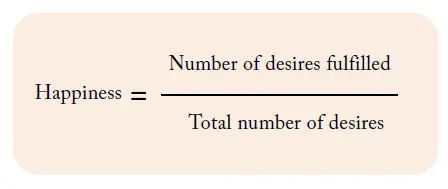
Daaji offers a simple formula that captures this same truth in modern terms: happiness is the ratio of desires fulfilled to desires held. The more desires we accumulate, the harder they become to satisfy, and the further happiness slips away—until, in a state of desirelessness, happiness becomes limitless. Ram Chandra of Shahjahanpur expressed this same wisdom in a phrase often quoted by Daaji—“more and more of less and less”—a gentle call to steadily minimize our wants until they dissolve entirely, for it is only in that emptiness, in making peace with oneself, that infinite happiness and bliss are found.
Meditation [dhyana], concentration [dharana], relaxation, and mindful breathing gradually still the restless mind. Modern neuroscience confirms that these practices reduce anxiety, enhance attention, improve emotional regulation, and strengthen resilience. Yoga does not eliminate life’s challenges; it transforms how we respond to them.
Harmony: The Social Dimension of Health
At its core, Yoga's greatest contribution is cultivating harmony—within ourselves, in our relationships with others, and ultimately with the whole of creation. According to Maharishi Patanjali, this journey begins with the yamas, the ethical restraints that form the foundation of yogic living and nurture the social dimension of health.
अहिंसासत्यास्तेयब्रह्मचर्यापरिग्रहा यमाः॥
ahiṁsā-satyāsteya-brahmacaryāparigrahā
yamāḥ ॥
“Non-violence [ahimsa], truthfulness [satya], non-stealing [asteya], moderation and right use of energy [brahmacharya], and non-possessiveness [aparigraha] are the yamas.” —Yoga Sutra II.30
The five yamas are more than moral rules—they are practical guides for compassion, integrity, moderation, and respect. Living these values brings harmony to our families, our communities, and ourselves.
Patanjali goes further, describing the yamas as universal in scope—binding regardless of birth, place, time, or circumstance:
जातिदेशकालसमयानवच्छिन्नाः सार्वभौमा महाव्रतम्॥
jāti-deśa-kāla-samayānavacchinnāḥ sārvabhaumā mahāvratam ॥
“These, being universal and not limited by class, place, time, or circumstance, constitute the great vow [mahavrata].” —Yoga Sutra II.31
This ideal of harmonious living finds its fullest expression in the Bhagavad Gita, where Lord Krishna describes the qualities of the true yogi:
अद्वेष्टा सर्वभूतानां मैत्रः करुण एव च। निर्ममो निरहङ्कारः समदुःखसुखः क्षमी॥
संतुष्टः सततं योगी यतात्मा दृढनिश्चयः। मय्यर्पितमनोबुद्धिर्यो मद्भक्तः स मे प्रियः॥
adveṣhṭā sarva-bhūtānāṁ maitraḥ
karuṇa eva cha,
nirmamo nirahankāraḥ sama-duḥkha-sukhaḥ kṣamī॥
santuṣhṭaḥ satataṁ yogī yatātmā
dṛiḍha-niśhchayaḥ,
mayy arpita-mano-buddhir yo mad-bhaktaḥ sa me priyaḥ ॥
“One who is free from hatred toward all beings, who is friendly and compassionate, free from possessiveness and ego, balanced in pleasure and pain, forgiving, ever content, self-controlled, steadfast in resolve, with mind and intellect dedicated to the Divine—such a devotee is dear to Me.” —Bhagavad Gita 12.13–14
“One who is free from hatred toward all beings,
who is friendly and compassionate,
free from possessiveness and ego,
balanced in pleasure and pain,
forgiving, ever content,
self-controlled, steadfast in resolve,
with mind and intellect dedicated to the Divine—
such a devotee is dear to Me.”
This is not merely a spiritual ideal but a practical blueprint for healthy living. Harmony, therefore, is not passive acceptance—it is an active expression of love, responsibility, self-awareness, and conscious living.
Conclusion
The ancient Vedic prayer expresses this universal aspiration:
ॐ सर्वे भवन्तु सुखिनः सर्वे सन्तु निरामयाः।
सर्वे भद्राणि पश्यन्तु मा कश्चिद्दुःखभाग्भवेत्॥
ॐ शान्तिः शान्तिः शान्तिः॥
oṃ sarve bhavantu sukhinaḥ sarve santu nirāmayāḥ,
sarve bhadrāṇi paśyantu mā kaścid duḥkha bhāg bhavet॥
oṃ śāntiḥ śāntiḥ śāntiḥ ॥
“May all be happy. May all be free from disease. May all experience auspiciousness. May none suffer. Om, peace, peace, peace.” —Vedic shanti mantra
This timeless blessing reflects Yoga's true purpose. It is not merely to perfect the body or quiet the mind, but to awaken our innate capacity for compassionate, conscious, and harmonious living.
The world may continue to move at an ever-increasing pace. Yoga reminds us that true peace is not found by escaping the world, but by finding our center within it.
As every conscious breath reconnects us with the present moment, every mindful action becomes an expression of Yoga—and health, happiness, and harmony cease to be distant ideals, becoming the natural fruits of a life lived with awareness. The journey is already underway; it is yours to continue.
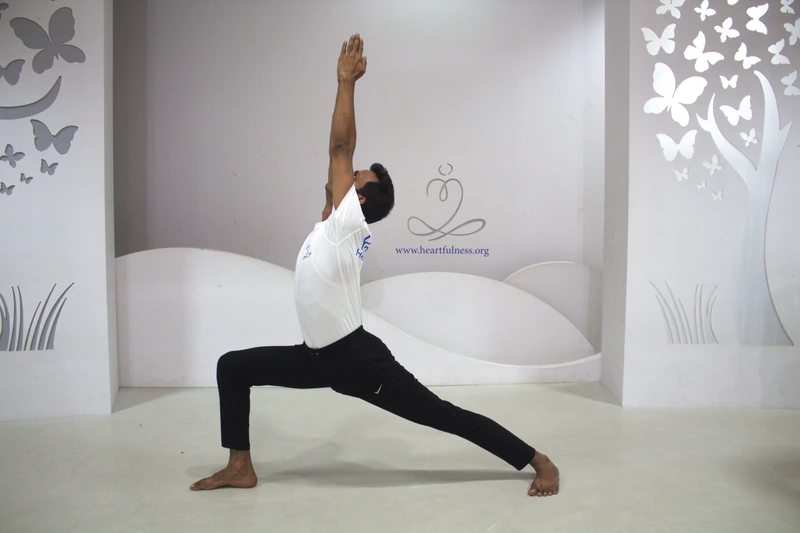
FROM THE HEARTFULNESS YOGA ACADEMY
Heartfulness Yoga Academy offers accredited, tradition-rooted programs that integrate asanas, pranayama, and Heartfulness Meditation with Yogic Transmission for a holistic approach to Yoga.
yogaacademy.heartfulness.org


Bhushan Bhukte
Bhushan is a certified yoga teacher with over 12 years of experience. He develops Yoga Certification Board–aligned teaching materials and therapeutic yoga modules for various health conditions. At the Heartful... Read More
