
A Book Review
In Five Prescriptions for the Soul, Daaji takes one of India’s most uncompromising teachings and does something rather audacious with it: he asks what enlightenment looks like when it has to survive Monday morning at work.
BY EKTA BOUDERLIQUE
Out of sheer habit, I venture into the airport bookshop, which is lined, rather ominously, with self-help books. There are books telling me how to think, eat, sleep, love, lead, age, succeed, heal, and apparently, become the most optimized version of myself before boarding even begins. Faced with so much improvement, giving up on self-development suddenly feels wonderfully human.
Daaji’s new book is already in my bag. I had picked up a copy at its launch earlier in the trip, and, amid the usual commotion of travel, had not yet found the time to read it. Now, as the flight takes off, I open Five Prescriptions for the Soul from the Ashtavakra Mahagita. That wonderful smell of a newly printed book exhilarates me, and I confess to approaching it with particular curiosity.
Many may know Ashtavakra's story, but the Ashtavakra Gita is hardly light reading. It is one of those magnificent Indian texts that wastes very little time reassuring the reader. Its proposition is radical: you are already free; you have just mistaken yourself for someone who isn't.
And now Daaji has written a book about it, with an unusual title.
Those who know me will hardly expect complete impartiality when it comes to Daaji, so let me dispense with that pretense immediately. I know him well enough to be both tender and occasionally amused by the unexpected directions his teachings take, even as I admit that familiarity may be a dangerous advantage for a reviewer.
But the title already has me smiling. Daaji spent more than three decades as a pharmacist in New York, and here he is, after all these years, still writing prescriptions. Five of them, this time.
A few pages later, however, my smile fades into serious focus. This is so not a self-help book! Or, if it is, it is the most subversive one I have encountered, since, somewhere along the way, it begins questioning the existence of the very self we are so industriously trying to improve.
Later, I muse on the impressive number of methods we develop for escaping our limited selves. We pray, meditate, fall in love, run marathons, paint, and listen to music, as we fight back the pain of life’s endlessly mundane challenges. The methods may differ, yet the hope beneath them is oddly consistent. How many times have we thought, if only for a moment: Could the person carrying my life please disappear?
Enter Ashtavakra.
This ancient Indian text featuring the young sage proposes a more inconvenient possibility. While we seek escape from ourselves, perhaps the deeper issue is that we have mistaken ourselves for something that was never quite us in the first place. It is, I realize with a huge sigh, such a liberating thought—though a very upsetting one as well.
At the center of the book is the famous dialogue between King Janaka and Ashtavakra. Janaka possesses almost everything the modern world teaches us to acquire: wealth, position, intelligence, learning, and influence. Yet he remains restless. Daaji captures his condition in one beautiful sentence: “The gap between knowing and being was the wound he carried.”
Daaji captures his condition in one
beautiful sentence: “The gap between knowing
and being was the wound he carried.”
There, I think, lies the reason this ancient conversation feels so contemporary.
We may be the most advice-saturated civilization in history. We know astonishing amounts about the brain, trauma, dopamine, sleep, relationships, emotional intelligence, productivity, and well-being. We have podcasts explaining how to breathe, and watches reminding us when to work out and even when to eat. Knowledge about how to live has become almost embarrassingly abundant. Yet the state of our planet and its inhabitants somehow contradicts all this evidence that we have consequently become better at living.
Janaka’s questions therefore travel remarkably well across thousands of years, now landing in my hands through Daaji’s book: How do I attain knowledge? How do I become free? How do I loosen attachment?
Ashtavakra’s answer is almost absurdly economical: kshama, arjava, daya, santosha, and satya—forgiveness, sincerity, compassion, contentment, and truth.
Five qualities. Five medicines.
This could easily become a neat five-step program with a cheerful diagram at the end. Daaji does something much more interesting. Each prescription initially appears to improve the patient, until we slowly discover that the patient is precisely what is under investigation.
The patient, it turns out, is the self.
This is where Daaji succeeds in making Ashtavakra unusually accessible without domesticating him. It is perfectly possible to read and even understand the philosophy of nonduality beautifully, and remain furious with one’s brother, parent, colleague, or friend for years. One may discourse magnificently on detachment and still be offended because somebody failed to answer a WhatsApp message. For most of us, there is a considerable distance between metaphysical understanding and Sunday lunch with the family or Monday morning at work.
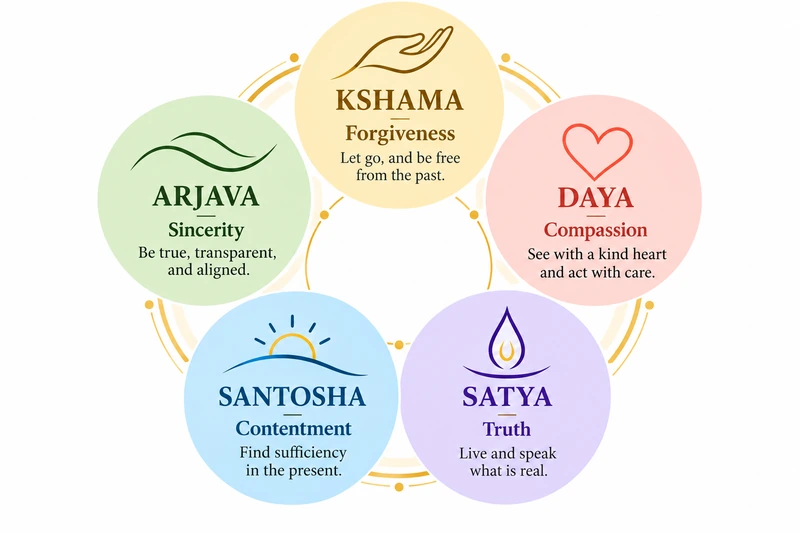
Daaji puts the book squarely into that gap.
He shows us how forgiveness loosens the past, how sincerity closes the distance between who we are and the persona we perform, like an actor on the proverbial stage. He explains how compassion dissolves the hard frontier between “me” and “you,” how contentment challenges the extraordinary authority we give circumstances over our inner states, and how truth eventually turns around and questions the one experiencing all of this.
He explains how compassion dissolves the
hard frontier between “me” and “you,” how contentment
challenges the extraordinary authority we give
circumstances over our inner states, and how truth
eventually turns around and questions the
one experiencing all of this.
Who, exactly, is this I that has been offended, disappointed, praised, ignored, satisfied, dissatisfied, forgiven, and transformed?
This is where the book changes its scale. What began as five beautiful human qualities becomes an inquiry into consciousness itself.
And yet Daaji reaches this enormous question through almost embarrassingly ordinary situations: resentment, pretense, expectations, relationships, ambition, hurt, and desire.
These seemingly ordinary things gain mass as we accumulate their heaviness. A grievance here, an expectation there, an identity we must defend, a role we have performed for so long that we no longer remember how or why it all began. Eventually their gravitational pull feels so natural that we simply call it “life.”
Daaji’s prescriptions work in the opposite direction. They remove weight. The book does not give you wings; it removes the ballast.
Of course, many moments in human life cause the usual sense of self to recede. We know them in meditation, music, creativity, sport, love, beauty, and service—those rare intervals when the commentator inside us falls silent and we simply are. But the intriguing question is what happens afterward. The music stops. The meditation ends. Someone says precisely the wrong thing at breakfast, and our carefully reconstructed self immediately reports for duty.
Daaji is interested in that reconstruction.
His inquiry into how we rebuild our prisons again and again may be more useful than simply seeking another fleeting experience of freedom. For me, that's where Five Prescriptions for the Soul becomes far more than a commentary on an ancient text. It offers a practical bridge between glimpsing something profound and living it.
His inquiry into how we rebuild our prisons again
and again may be more useful than simply
seeking another fleeting experience of freedom.

Then, just when one might fear that all this nonduality is becoming terribly serious, Daaji does something rather unexpected. Throughout the book, he draws upon familiar scenes and characters from popular Indian films to illuminate Ashtavakra’s ideas. Kabhi Khushi Kabhie Gham, Taare Zameen Par, Dear Zindagi, Rang De Basanti, Lagaan, and Anand share pages with Sanskrit philosophy. On paper, the combination sounds improbable. In practice, it works remarkably well.
A Sanskrit concept may require several paragraphs of exposition, whereas a character or scene we have loved on a cinema screen already occupies a cherished place in Indians’ collective emotional memory. The film references are not merely decorative, nor do they try to make ancient philosophy fashionable. Daaji uses their familiarity as a doorway. They allow an unfamiliar idea to land in familiar human experience.
At one point, Daaji revisits the film Anand through an entirely different philosophical lens. The movie has not changed. What has changed is the perspective from which we see it. In this way, Daaji offers a new entry point for readers who might otherwise never encounter this magnificent teaching.
For a Heartfulness practitioner, the book contains another layer of particular interest: Daaji maps the five prescriptions onto the five points, or chakras, of the heart, and their corresponding elements within the Heartfulness system. What initially appears to be an ethical sequence reveals itself as an inner geography of transformation.
The book is careful about the provenance of this map because it is not presented as something taken from classical yogic literature, but as experiential knowledge transmitted through the Heartfulness lineage. For Heartfulness practitioners, that distinction makes the exploration more interesting, since the qualities of forgiveness, sincerity, compassion, contentment, and truth have specific locations within our physical bodies and can be explored there through direct experience.
Daaji bridges the distance between
understanding nonduality as a
philosophical truth and arriving at it through
personal experience.

Here, Daaji bridges the distance between understanding nonduality as a philosophical truth and arriving at it through personal experience.
“If I am already free, why must I practice?” is not an unreasonable question. Nor is: “If the separate self is ultimately an illusion, who exactly is being liberated?”
This book offers a wonderfully unspectacular answer: Begin with the person you still cannot forgive. Notice where you are pretending. Notice whom your compassion does not include. Notice what you insist must happen before you permit yourself contentment. Then ask what is true. You do not have to begin with enlightenment. Yesterday’s argument will do just fine.
By the time we arrive at satya, the five prescriptions that appeared initially to be improving the self have now turned the light upon the self receiving the treatment. Daaji uses the image of a porter carrying luggage to illustrate the self, bearing its burdens: once the luggage has been dispensed with, what need is there for the porter?
The treatment has now consumed the patient. Perhaps that is why I found the book unusually powerful. As a contemporary culture, we are so addicted to addition. More knowledge, more achievement, more purpose, more productivity, more experience, more techniques, more optimization, even more extraordinary states of consciousness. We accumulate solutions to the burden of accumulation—only adding to our burden.
Daaji, with considerable elegance, proposes subtraction instead. One grievance less. One mask less. One boundary less fiercely defended. One outcome upon which happiness no longer depends. One illusion surrendered.
Perhaps this is the real achievement of Five Prescriptions for the Soul. Daaji does not so much bring Ashtavakra into the modern world as reveal that Ashtavakra never really left it. That ancient sage has been hiding in our marriages and meetings, our ambitions and disappointments, our prayers and our meditations, our movies, and our Sunday lunches and Monday mornings, lingering all the while, waiting patiently inside the stubborn little pronoun around which we arrange almost everything: “I.”
Janaka thought freedom required one more acquisition. Our pharmacist sage, Daaji, gives him five medicines instead. One by one, they take something away, leaving behind what we all need to discover. As I close my eyes and plunge into meditation, the book begins its work of unraveling within my heart.
References:
Patel, Kamlesh D. (Daaji). Five Prescriptions for the Soul from the Ashtavakra Mahagita. Jaico Publishing House, 2026.

Ekta Bouderlique
Ekta is a therapist and integrative wellness advocate with over three decades of Heartfulness practice and teaching. She leads government relations and regional work for the Heartfulness Institute, heads Energy Medicine at Wellness by He... Read More
