
At a Heartfulness meditation retreat, safe spaces, nature, and community fostered a depth of belonging that shifted how young participants saw themselves and their purpose—a finding with implications for youth mental health.
BY DR HESTER O’CONNOR AND VIVEK SHEKHAR
In recent years, loneliness has been described as an epidemic, affecting people of all ages. The U.S. Surgeon General warned in 2023 that social isolation poses health risks comparable to smoking 15 cigarettes a day. The World Health Organization followed suit, declaring loneliness a global public health concern. The crisis is particularly acute for young people: despite digital hyperconnection, many feel more isolated than ever.
Against this backdrop, a study published in OBM Integrative and Complementary Medicine in 2026 offers a possible antidote.1 Heartfulness researchers Vivek Shekhar and Hester O’Connor explored the experiences of Indian youth during a retreat at Kanha Shanti Vanam meditation center in Hyderabad. What the participants reported was not just relaxation or stress relief, but something deeper—a sense of belonging, transformation, and peace that was life-changing.
A Retreat in the Heart of India
Kanha Shanti Vanam blends spiritual practice with environmental stewardship through organic farming, tree planting, and conservation projects. In 2024, the center hosted “Youth Unite,” a three-day retreat for 128 students. The study focused on in-depth interviews with ten young adults (18–27) visiting Kanha for the first time.
The setting itself played a crucial role. Participants spoke of Kanha as a “mother”—a safe, nurturing environment where they could let their guard down. The natural beauty, the rhythm of meditation, and the absence of judgment created what psychologists might call a “container,” a space where people feel secure enough to explore themselves.
The Power of Belonging
One of the most striking findings was the sense of belonging participants experienced. In a society where academic pressure, family expectations, and stigma around mental health often isolate young people, Kanha offered something rare: community. Several described feeling as if they had found a family. Others spoke of falling in love with the place itself, as though the land and the people together offered a loving embrace.
This echoes what developmental psychologists have long theorized: people thrive when they feel securely attached. Just as infants need a caregiver’s presence to explore the world, young adults need spaces where they feel accepted to take risks, dream, and grow. At Kanha, belonging extended beyond human relationships to include nature itself. Participants described trees, gardens, and the atmosphere as part of their community. One participant summed her experience as follows:
“All that I need in my life is only love. And in Kanha, I felt love in every inch of that. What I am feeling. I’m actually speechless. What I am feeling about Kanha can’t be expressed in words. It is another kind of love, which I hadn’t experienced before. That you belong to Kanha… My heart is beating, my veins are pumping. My mind is working. So, in every inch of my body, I felt that. And secondly, I felt my soul.” —Hamaza, study participant.
Transformation and Purpose
Beyond belonging, the retreat sparked transformation. Participants reported new clarity about their goals. One young man decided to shift from medicine to agriculture after failing the MBBS entrance exam, calling himself a “doctor of plants.” Another resolved to tackle global hunger through farming, saying, “A single grain of rice has importance.” These are not trivial changes—they represent a reorientation of life purpose.
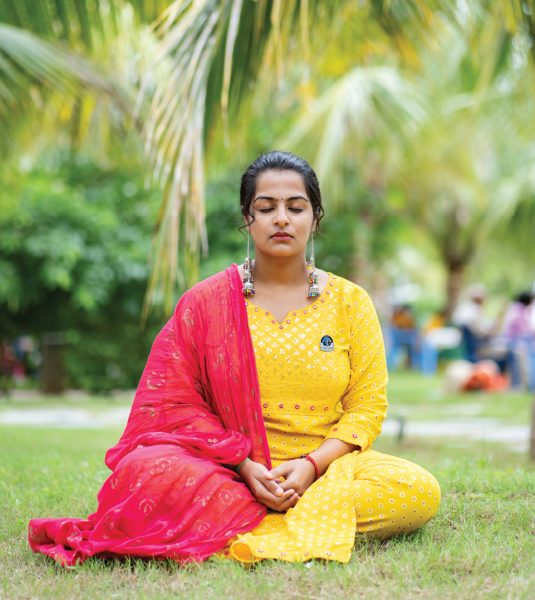
Such transformations highlight the potential of contemplative practices to do more than soothe stress. They can catalyze meaning-making, helping individuals reframe their identities and aspirations. In a world where many young people feel adrift, this sense of agency is invaluable.
Why Safe Spaces Matter
The study’s findings resonate with broader psychological theories. Donald Winnicott spoke of the “holding environment,” Wilfred Bion of “containment,” and John Bowlby of the “secure base.” All point to the same truth: people need safe spaces to grow. For Indian youth, who face intense competition and limited mental health resources, retreats like Kanha may provide a crucial buffer.
Caveats and Future Directions
The study has limitations. With a self-selecting sample of ten, the findings cannot be generalized. The interviews took place immediately after the retreat, raising the possibility of “afterglow” effects—temporary euphoria that may fade. Long-term studies are needed to see whether the sense of belonging and transformation persists months or years later.
In an age of digital distraction and social
fragmentation, spaces like Kanha Shanti
Vanam demonstrate how belonging can
be cultivated—not through algorithms or
likes, but through meditation, community,
and connection to nature.
A Glimpse of What’s Possible
At its heart, the study reminds us of something simple yet profound: humans need spaces where they can belong to thrive. In an age of digital distraction and social fragmentation, spaces like Kanha Shanti Vanam demonstrate how belonging can be cultivated—not through algorithms or likes, but through meditation, community, and connection to nature.
For the young people who attended the retreat, it was “magic.” That magic, rooted in belonging and connection, may be the foundation our lonely world needs to move toward healing and growth.
FROM HEARTFULNESS RESEARCH
Heartfulness Research studies the effects of meditation from both neuroscientific and qualitative perspectives.
heartfulnessinstitute.org/research/
1 Shekhar V, O Connor H. Transformational Spaces: An Interpretative Phenomenological Inquiry into the Lived Experience of Young People Visiting Kanha Shanti Vanam Meditation Center, Telangana, India. OBM Integrative and Complementary Medicine 2026; 11(1) 007; doi:10.21926/obm.icm.2601007.

Hester O Connor

Vivek Shekhar
Vivek is an education specialist whose experience spans fields including mathematics, engineering, and organizational development. Vivek advises researchers on experimental design for quantitative and qualitat... Read More
