
New research shows that Heartfulness meditation can ease burnout, support well-being, and measurably change the body’s stress response.
By Dr. Mansee Thakur
Meditation has moved from the margins of spiritual practice into the mainstream of science. Researchers are increasingly asking whether the inner changes people experience through meditation can also be measured in the body. A 2025 study published in Stress and Health adds intriguing evidence: Heartfulness meditation appears to reduce stress biomarkers and burnout while enhancing overall well-being in young adults.
The impact of stress
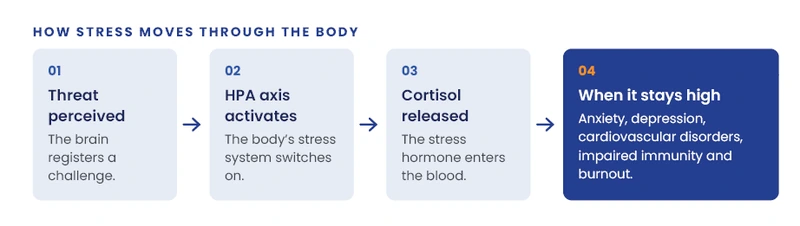
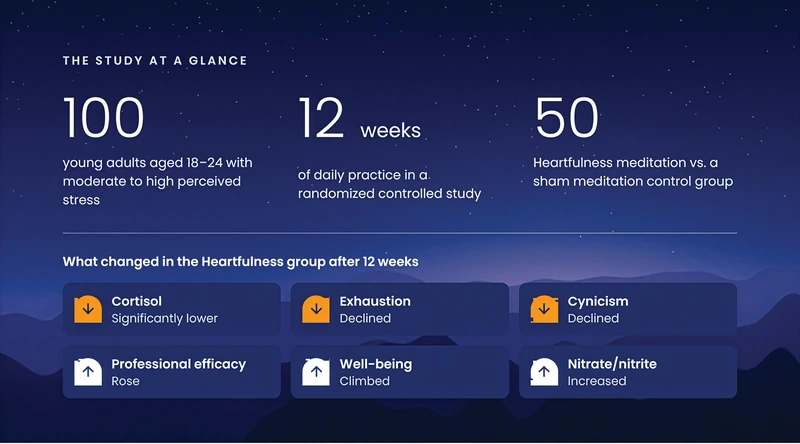
Mental health is a vital component of overall health and well-being, and the rising prevalence of mental health problems has become a major public health concern. Stress triggers a cascade of biochemical responses. When the brain perceives a threat, it activates the hypothalamic-pituitary-adrenal (HPA) axis, signaling the adrenal glands to release cortisol into the bloodstream. While this response prepares the body to cope with immediate challenges, prolonged cortisol elevation contributes to anxiety, depression, cardiovascular disorders, impaired immunity, and burnout characterized by exhaustion, detachment, and reduced performance. Young adults are particularly vulnerable to these effects. Against this backdrop, researchers in India investigated whether Heartfulness meditation could effectively reduce stress as a non-pharmacological intervention. The randomized controlled study enrolled 100 participants aged 18–24 years with moderate to high perceived stress. Fifty participants practiced Heartfulness meditation daily for 12 weeks, while the remaining 50 were assigned to a sham meditation program as the control group, allowing an objective comparison of outcomes.
Measuring the Invisible Signs of Stress
The investigators did not rely on self-reports alone. They measured serum cortisol to track psychological stress, nitrate/nitrite levels as indicators of protective antioxidant activity, and malondialdehyde (MDA). Psychological outcomes were assessed using the Maslach Burnout Inventory and the World Health Organization’s Well-Being Index.
This dual approach combining subjective scales with objective biomarkers allowed the team to capture both the lived experience of stress and its hidden biochemical signatures.
Heartfulness meditation
appears to reduce stress
biomarkers and burnout
while enhancing overall
well-being in young adults.
The Findings
After 12 weeks, the differences between the groups were striking. Participants in the Heartfulness group showed a significant reduction in cortisol. Burnout scores improved: exhaustion and cynicism declined, while professional efficacy rose. Well-being scores climbed too, reflecting a more positive outlook on life.
Biochemically, the meditation group exhibited increased nitrate/nitrite levels, associated with protective antioxidant activity. Meanwhile, MDA levels correlated negatively with well-being, reinforcing the link between oxidative stress and psychological distress. In short, Heartfulness meditation appeared to recalibrate both mind and body.

Why Heartfulness?
This study explored Heartfulness meditation as a preventive measure to improve overall health and well-being in young adults. The results support the positive effects of Heartfulness meditation on stress biomarkers, burnout, and well-being. In this study, Heartfulness meditation, with its distinctive feature of Yogic Transmission, significantly reduced stress among young adults facing a range of life stressors.
Caveats
The study has its limitations. The study included only 100 young adults and lasted 12 weeks, so it remains unclear whether the effects persist over time. The participants were also relatively homogeneous in age and cultural background, raising questions about generalizability to more diverse populations. Sham meditation, while a useful control, may not perfectly mimic the expectancy effects of genuine practice.
Still, the findings align with a broader literature suggesting that contemplative practices can modulate stress physiology. They add a valuable piece to the puzzle: Meditation is not merely a subjective balm but a measurable intervention with real biochemical consequences.
Implications for Mental Health
The implications are profound. If a simple, no-cost practice such as Heartfulness can reduce cortisol and improve well-being, it could complement existing therapies for stress and burnout. Universities, workplaces, and healthcare systems might consider integrating Heartfulness sessions into their wellness programs. For individuals, the message is empowering: cultivating calm through meditation may literally reshape the body’s stress response.
The Heart Holds the Key
The study offers a compelling message: in a world where stress is widespread, the heart may hold the key to resilience. By turning inward through Heartfulness meditation, young adults experienced not only psychological relief but also measurable biochemical evidence of healing. These findings support the growing scientific understanding that the mind and body are deeply interconnected, and that contemplative practices like Heartfulness can restore balance, strengthen resilience, and foster inner harmony.
FROM HEARTFULNESS RESEARCH
Heartfulness Research studies the effects of meditation from both neuroscientific and qualitative perspectives.
heartfulnessinstitute.org/research/
Source:
Mansee Thakur, Sanjana T. Philip, Kunal R. Desai, and Kapil Thakur, “Effect of Heartfulness Meditation on Stress Biomarkers, Burnout and Well-Being: A Randomized Controlled Study,” Stress and Health (2025), https://pubmed.ncbi.nlm.nih.gov/40271908/

Dr. Mansee Thakur
Dr. Mansee Thakur is Dean of the Faculty of AHCP at MGMIHS, Navi Mumbai, and a certified Heartfulness Trainer. Her research
explores the molecular effects of meditation through biomarkers, gene expression, and mitocho... Read More
